


2079 PABSON KATHMANDU BOARD EXAMINATION
Class 9Science
Answers On/OffJS required
Group A
- Q1.पिको उपसगंको गुणाङ्क कुन हो ? (What is the coefficient of Pico Prefix?)(i) 10^9(ii)10^12(iii) 10^-9(iv) 10^-12A.(iii) 10^-9
- Q2.जीवहरूको वर्गीकरणमा दिइएकोमा कुन क्रम Which one of the following is the correct order in classification of organism?(i) Kingdom phylum order family class genus species(ii) Kingdom, phylum. class, order, family. genus, species(iii) Phylum, kingdom family. class, order. genus species(iv) Kingdom, phylum, family, order, genus, speciesA.(ii) Kingdom, phylum. class, order, family. genus, species
- Q3.मृगौलाको नलीहरू र गर्भाशयको भित्री भागको सतहमा कस्तो तन्तुहरू पाइन्छ? What is the tissue on the inner surface of the tubes of kidney and uterus?(i) कोलम्नार पिथेलियम तन्तु (Columnnar epithelium tissue)(ii) ग्लान्डुरस तन्तु (Glandular epitheliums tissue)(iii) स्वयामस इपिथेलियम तन्तु (Squamous epithelium tissue)(iv) क्युलोइडल इपिथेलियम तन्तु (Cuboidal epithelium tissue)A.(i) कोलम्नार पिथेलियम तन्तु (Columnnar epithelium tissue)
- Q4.पोखरीको पारिस्थितिक पद्धतिमा पाइने सुक्ष्म वनस्पतिहरूलाई के भनिन्छ। What is called for the microscopic plants found in pond ecosystem?(i) क्लाइडोमोनस (Chalmy-domonas)(ii) गुप्ताक्टन (Zooplankton)(iii) टेरिया (Bacteria)(iv) फाइटोप्लाङ्क्टन (Phytoplantkron)A.(iv) फाइटोप्लाङ्क्टन (Phytoplantkron)
- Q5.1 कोलम्ब चार्जमा कति इलेक्ट्रोन हुन्छ ? (How many electrons are there in 1 coloumb charge ?)(i) 6.25 × 10^18 electrons(ii) 6.25 × 10^23 electrons(in)6 x 10^18 electrons(iv) 6 x 10^23 electronsA.(i) 6.25 × 10^18 electrons
- Q6.एउटा परमाणुको भार 40 र पारमाविका 20 प्रोटोनको समा पत्ता लगाउनुहोस् । An atom has mass 40 and atomic number 20. Find the number of protons.(i) 40(ii) 20(iii) 19(iv) 22A.(ii) 20
- Q7.कपरको पग्लिने तापक्रम____ हो । (The melting point of copper is .)(i) 1553 °C(ii) 1535 °C(iii) 1083 °C(iv) 956 °CA.(iii) 1083 °C
- Q8.विद्युतीय रूपमा धनात्मक चार्ज हुने रेडिकललाई……….(Electrically positively charged radicals are called…….)(i) एनायोन (anions)(ii) स्थापोड (Cathode)(iii) एनोड (Anode)(iv) CationsA.(iv) Cations
- Q9."म धुलाका कणहरू र सहरू मिलेर बनेको माइन्ट पिण्ड हुँ ।" म को हुँ? I am a giant mass formed from a combination of dust particles and gases. Who am I?(i) नेबुला (Nebula)(ii) प्रोटोस्टार (Proto star)(iii) रेड जाइन्ट (Red giant)(iv) न्युट्रोन (Neutron star)A.(i) नेबुला (Nebula)
- Q10.कुनचाहि रहले एकदमै धेरै विचाक्त किटनाशक विभाजन ? Which of the following colour refers highly toxic insecticides?(i) रातो (Red)(ii) हरियो (Green)(iii) पहेंलो (Yellow)(iv) मिल्की (Blue)A.(i) रातो (Red)
Group B
- Q1.GPS प्रविधिको एउटा उपयोगिता लेखनुहोस् । (Write an application of GPS technology.)A.GPS is used for navigation in vehicles, airplanes, and ships.
- Q2.इन्टरक्यालरी बेरिस्टमको परिभाषा दिनुहोस् । (Define intercalary meristem.)A.It is a type of meristematic tissue found at the base of leaves and internodes, helping in the growth of plants.
- Q3.चार्ल्स डार्विनले क्रम विकासका बारेमा प्रकाशान गरेका पुस्तकको नाम लेबनुहोस् । Write the name of the book published by Charles Darwin about evolution.A.On the Origin of Species
- Q4.थाइराइड ग्रन्थीले उत्पादन गर्ने कुनै दुई हर्मोनको नाम लेख्नुहोस् । (Name any two hormone produced by thyroid gland)A.Thyroxine (T4) and Triiodothyronine (T3)
- Q5.मोमेन्टमलाई परिभाषित गर्नुहोस् । (Define the term momentum.)A.Momentum is the product of the mass and velocity of an object. It is given by:Momentum (p) = mass (m) × velocity (v)
- Q6.सन्तुलित बल भन्नाले के बुझिन्छ ? (What is meant by balanced force?)A.When two or more forces acting on an object cancel each other out and do not change the object's motion, they are called balanced forces.
- Q7.3Mg (HCO3)2:- अणुमा परमाणु '' को सङ्ख्या कति छ ? (What is the number of O atom in the molecule 3 Mg (HCO3)2?A.3 × (1 Mg + 2 × (1 H + 1 C + 3 O))= 3 × (1 + 2 × 5) = 3 × 11 = 33 atoms
- Q8.एमोनिया ग्याँस बनाउन कुन उत्प्रेरकको प्रयोग गर्नुपर्छ ? (Which catalyst has to be used to prepare ammonia gras?)A.Iron (Fe) is used as a catalyst in the Haber process.
- Q9.अर्धधातुलाई परिभाषित गर्नुहोस् । (Define metalloids.)A.Metalloids are elements that have properties of both metals and non-metals. Examples: Silicon (Si), Boron (B).

Practice Without Boundaries.
Premium gives you full access, zero ads, and unlimited custom paper generation. Study your way, every day.

Group C
- Q10.शिर क्षेत्रमा विज्ञानका नै दुई उपलब्धीहरू लेख्नुहोस् । (Mention any two achievements of science in the field of education.)A.
- Development of online learning platforms (e.g., Google Classroom, Zoom).
- Use of digital smart boards and projectors for interactive learning.
- Q11.भारको बनोटको नामाङ्कित चित्र कोर्नुहोस् । (Draw labeled diagram of structure of mushroom.)
- Q12.पारिबोटिक र पुस्यारिओटिक विचका भिन्नता लेख्नुहोस् । (Differentiate between prokaryotes and eukaryotes.)A.
Table
Prokaryotes Eukaryotes No nucleus Has a nucleus Simple cell structure Complex cell structure No membrane-bound organelles Has membrane-bound organelles Example: Bacteria Example: Humans, Plants - Q13.को अर्थ उदाहरणसहित प्रष्ट पार्नुहोस् । (Clarify the meaning of "Survival of the finest with example.)A.
- It means organisms best adapted to their environment survive and reproduce.
Example: Giraffes with longer necks survived because they could reach tall trees for food, while shorter-necked giraffes died - Q14.पतिको वृद्धि हर्मोनका कुनै दुई प्रयोग लेख्नुहोस् । (Write any two uses of plant growth hormone)A.
- Helps in seed germination.
- Increases fruit and flower growth.
- Q15.बब 300 g पिण्डमा 20 N बल लगाइन्छ कति प्रवेग उत्पन्न हुन्छ ? What acceleration is produced on a mass of 300 g, when a force of 20 N is applied on it?A.
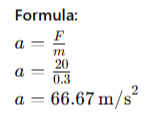
- Q16.जब एउटा मान्छे हाँगाको टुप्पोतिर जाँदा हाँगा भाँचिने सम्भावना बढ्छ । कारण दिनुहोस् । Possibility of breaking the branch increases when a person goes to the tip of the branch. Give reason.A.When a person moves to the tip, the torque (moment of force) increases, causing the branch to break.
- Q17.सबैको चित्रको अध्ययन गरी निम्न प्रश्नहरूको उत्तर दिनुहोस् ।Study the figure alongside and answer the following questions.
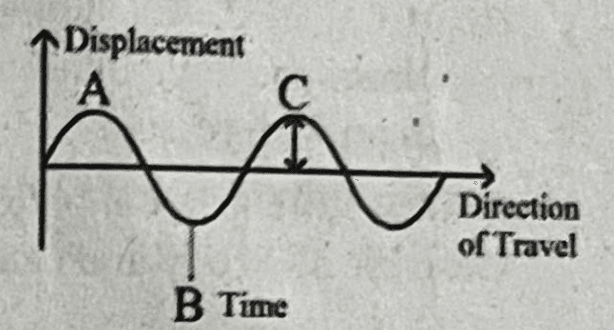 (a) विश्मा देखाइएको तरङ्गको प्रकार लेख्नुहोस् । (Name the type of wave shown in figure.)(b) A र C को नाम लेख्नुहोस् । (Label 'A' and 'C.)A.The wave shown is a Transverse Wave.A: CrestC: Amplitude
- Q18.सबै ताराहरूको रङ एउटै हुँदैन । किन ? (All the stars do not have the same colour. Why?)A.The color of a star depends on its temperature.
- Hot stars appear blue or white.
Cool stars appear red or orange. - Q19.माल्सियम क्लोराइडमा इलेक्ट्रोभ्यालेन्ट बन्ड कसरी बन्छ ? चित्रसहित प्रष्ट पार्नुहोस् । How is electrovalent bond formed in calcium chloride? Clarify with diagram.
- Q20.दिएको शब्द समीकरणलाई सन्तुलित सूत्र समीकरणमा परिवर्तन गर्नुहोस् । Change the given word equation into balanced formula equation. स्वात्सियम बाइकार्बनेट → क्याल्सियम कार्बोनेट पानी + कार्बनडाइअक्साइड Calcium bicarbonate → Calcium carbonate + water + carbondioxideA.Ca(HCO₃)₂→CaCO₃+H₂O+CO₂
- Q21.हाइड्रोजन पेरोक्साइडलाई म्यागानेज-डाइअक्साइडसँग मिसाएर तयार गरिने ग्याँस बनाउने तरिकाको सफा नामाङ्कित चित्र कोर्नुहोस् । Draw a neat and labeled diagram of a gas which is prepared by mixing hydrogen peroxide with Manganese dioxide.
- Q22.फायरवाल र एन्टिभाइरस विचका कुनै दुई भिन्नता लेख्नुहोस् । (Write any two differences between firewall and antivirus.)A.
Tables
Firewall Antivirus Protects the network from unauthorized access. Detects and removes malware/viruses. Works at network level. Works at file and software level. - Q23.किटनाशक विषादीको प्रयोग रहर हैन, बाध्यता हो।" यो भनाइलाई प्रष्ट पार्नुहोस् । The use of insecticide is not an interest but an obligation". Justify the statement.A.Without insecticides, crops get destroyed, leading to food shortages.Pests spread diseases, affecting humans and animals.Farmers must use insecticides to protect crops and ensure a stable food supply.
Group D
- Q24.हरेकको एक कार्य लेख्नुहोस् । (Write any one function of each.).A.(a) राता रक्तकोष (RBC): RBCs carry oxygen from the lungs to the rest of the body.(b) बाइलय तन्तु (Xylem tissue): Xylem tissue transports water and minerals from the roots to other parts of the plant.(c) इन्सुलिन हर्मोन (Insulin hormone): Insulin helps regulate the blood sugar level by allowing cells to absorb glucose.(d) सेरेबेलम (Cerebellum): The cerebellum controls balance, posture, and coordination of movements
- Q25.दिइएको तालिका अध्ययन गरी निम्न प्रश्नहरूको उत्तर दिनुहोस् । Study the given chart and answer the followings.
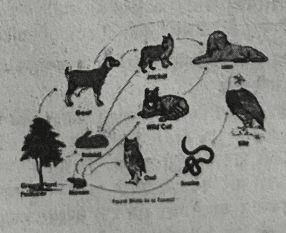 (a) उसने कस्तो प्रकारको पारिस्थितिक पद्धतिलाई जनाउँछ ? What type of ecosystem does it represent?(b) यो वाच चक्रका सबै सिंहहरूलाई मारियो भने के हुन्छ ? What happens when all the lions of food cycle are killed?(c) एउटा प्राथमिक उपभोक्ता पहिचान गर्नुहोस् । (Identify a Primary consumer.)(d) को चित्रबाट एउटा उदाहरण दिँदै बाचजालको परिभाषा दिनुहोस् । Define food chain with one example from the figure alongside.A.It represents a terrestrial ecosystem.If all the lions are killed, the population of deer and rabbits will increase, leading to overgrazing and potential damage to the plant population.The rabbit is a primary consumer.A food chain is a sequence of organisms where each one is eaten by the next member in the chain. Example: Plant → Rabbit → Fox → Eagle.
- Q26.दिको उपकरण पहिचान गरी यसको कार्य सिद्धान्त वर्णन गर्नुहोस् । Identify the given equipment's and explain their working principle.
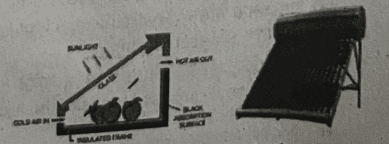 A.The equipment shown is a solar water heater. It works by using solar panels to absorb sunlight and convert it into heat, which is then used to heat water stored in a tank.
- Q27.मोनोग्राफी र एक्स रे फोटोग्राफी विच दुई भिन्नता लेख्नुहोस् । स्वास्थ्यको दुई मध्ये कुन चाँहि बढी सुरक्षित हुन्छ ? कारण सहित लेख्नुहोस् । Write two differences between ultrasonography and x-ray photography. Which one is safer out of them in the point of health? Write with reason.A.Differences:
- Ultrasonography uses sound waves to create images, while X-ray photography uses radiation.
- Ultrasonography is non-invasive and does not expose the body to radiation, while X-ray photography involves exposure to radiation.
Safer Option: Ultrasonography is safer because it does not use ionizing radiation, which can be harmful to the body with repeated exposure - Q28.दिइएको चित्र अध्ययन गरी निम्न प्रश्नहरूको उत्तर दिनुहोस् । Study the given figures and answer the following questions.
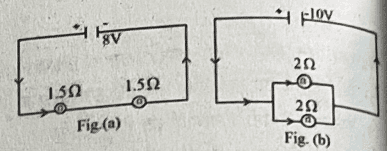 (a) चित्र (a) र (b) को लोडहरूको कस्तो जहान देखाइएको छ ? Which type of combination of loads is shown in fig (a) and fig (b).(b) परिपथ (a) र (b) मा कति करेन्ट बहन्छ ?How much current flows in the circuit (a) and (b)?A.
- Fig (a) shows loads in series.
- Fig (b) shows loads in parallel.
- In circuit (a), the current is 0.5 A (since 8V / 15Ω = 0.533 A, but considering ideal conditions, it's approximately 0.5 A).
- In circuit (b), the total current is 0.5 A (since 10V / 20Ω = 0.5 A).
- Q29.दिइएको तालिका अध्ययन गरी निम्न प्रश्नहरूको उत्तर दिनुहोस् । Study the given table and answer the following questions.
Table Questions
तत्त्व (Elements). इलेक्ट्रोनिक विन्यास (Electronic Configuration) A 2,6 B 2,8,1 C 2.8,7 (a) A र C को संयुज्यता कति हुन्छ ? किन ? (What is the valency of element 'A' and 'C' ? Why?)(b) B and C मिलेर बन्ने यौगिकको नाम लेख्नुहोस् । तिनीहरूविच बन्ने बन्डको प्रकार कारणसहित लेख्नुहोस् ।A.- Element A has a valency of 1 because it has 1 electron in its outermost shell (2, 6).
- Element C has a valency of 1 because it needs 1 electron to complete its outermost shell (2, 8, 7).
Name the compound formed by the combination of B and C. Write down the type of the bond formed between them with reason.- The compound formed is Sodium Chloride (NaCl).
- The bond formed is an ionic bond because element B (Sodium) loses an electron to become a cation, and element C (Chlorine) gains an electron to become an anion, resulting in an electrostatic attraction between them.
- Q30.कार्बनको एलोट्र्पी र क्याटिनेशनको गुणको उदाहरणसहित व्याख्या गर्नुहोस् । Describe allotropy and catenation property of carbon with examples.A.Allotropy: Allotropy is the property of an element to exist in different forms. Carbon exhibits allotropy as it exists in forms like diamond, graphite, and fullerenes.Catenation: Catenation is the ability of an element to form long chains or rings. Carbon shows catenation by forming long chains of carbon atoms, such as in alkanes (e.g., ethane, propane) and polymers (e.g., polyethylene).